http://shipyourenemiesglitter.com/
I’m really glad that site wasn’t around 15 years ago, LOL. Brilliant.
http://shipyourenemiesglitter.com/
I’m really glad that site wasn’t around 15 years ago, LOL. Brilliant.
I refuse to call this a resolution, more so it is an experiment for the month of January. I have been working out for the past year but not seeing the results I want physically (cardio and strength have increased). So for this month I will be cutting out all forms of alcohol. I figure at least my bank account will be happy. 
I won’t be updating about it daily so don’t worry, but I might post at the end if the results are what I expect. I figure worst thing that could happen is if I accidentally get a bit healthier.
For anyone who doesn’t know I got a gym membership for myself finally and now with my FitBit tracking me I can’t really turn a blind eye.
Found a cool violin version so here is a ringtone
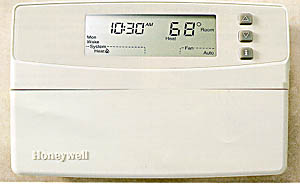
For about 10 years now (since we moved in) we’ve been using just your plain old normal Honeywell Programmable Thermostat (T8600 I believe) with out any real issues. Changing the batteries was a little annoying but really that’s just what you expect.
Flash forward to now and wifi connected smart thermostats have really come a long way. I always kept an eye on the Nest but the price was just too high for me. Recently though I learned of the Ecobee Smart SI and when I looked on Amazon the price was down to $135 for non touch screen so I pulled the trigger on it after doing a little reading. The wifi abilities and web control are cool but I was looking forward to getting long term data about how our furnace is performing.
The thermostat arrived but as I was checking the wiring I discovered i didn’t have a “C” wire ran all the way from my furnace to the thermostat location. It was wired up in the furnace but the wire ran to the AC unit, not up to the location. Oops. Fortunately my basement isn’t finished and running wires is well within my abilities so I ordered to replace the 4 conductor wire currently in place.
Why do we need the C connector and why isn’t it there already? Power. Apparently it’s a 24v AC line that most thermostats don’t need and honestly I’m happy to be away from batteries as the color screen and wifi would have consumed them quicker. Honestly it wasn’t hard to do and now I’m future proofed (even let me kids help feed me the line as I pulled the old out). All I had to do was hook the two wires together and use the old stuff to pull the new through the wall. One word of warning though on this specific wire and brand. The insulation is pretty much paper thin, so if your using wire strippers you have to be EXTRA careful! What you need to do is cut off an inch to get to the string inside and then pull back on that to remove the outside sheath to expose the inside strands.
So here are some pictures, to be honest the actual installation wasn’t really hard as the wires are color coded.
Original wiring and thermostat:

After lining up the new back the screws matched perfectly but the wire had to “jog” down a bit. There is a collar that comes with it that covers to old hole so no biggie really.
All that is left is to wire it up at the furnace and the Ecobee, for me with single stage gas and AC this was very simple:

*note I did NOT have the collar on at this point. I had to go back and add it to hide the hole.
And then you turn power back on and hope nothing explodes (note the added collar):
After that you go through some registration, enter a code on ecobee.com and you’re done! At least your done unless your a computer guy like me. I got a little curious so I put the Ecobee onto a sniffer so I could capture the traffic and make sure it’s encrypted. Long story short the unit phones home on port tcp 8089. First call is to ecobee.com (might be a bad design decision) and then they agree on a SSL certificate and all future communications are encrypted (at least according to Wireshark). The only thing I don’t have a full grasp on is how you can turn on your whole house fan with very low latency. It’s not just periodically phoning home like every 15 seconds that I can tell so that means it can contact the unit directly? That shouldn’t be possible via NAT but I’m not 100% sure. I will say that it seems the unit sets up a pretty strict firewall only allowing port 8089 communication from ecobee.com. I couldn’t telnet or ssh to it on 8089 and an nmap scan didn’t really turn up anything meaningful. At least it means it passes a first check of being at least a bit secure (looking at you Foscam IP cams!).
As for features as I mentioned earlier my interest is really in the long term data that won’t display until a full calendar month has passed so I haven’t really had a chance to judge on that. The email alerts for temp, filter change, etc are kind of cool. I do like walking by and seeing the inside and outside temp (per weather.com or something) and humidity. Plus it’s kind of cool you can pull up the 4 day weather on it. So that’s pretty much it, I needlessly overcomplicated something simple because internet!
They’ve been here a few days and so far are blending in well. Just a little shy but who could blame them after two months at a pet store.
Busted out the actual camcorder that does 1080p for this one.
I still think it’s a shame things with “Howl” didn’t work out with us but it’s important to remember that an animal has to *want* to live in a place. Cats are usually pretty adaptive but I guess with the dog, kids and other cats he just couldn’t adjust. On the bright side Calcifer is 100% super chill dude and fits in perfectly as you can see.

Had to believe that Tabitha just turned four already. I took her with me to early vote and despite the “technical difficulties” she hung in and was pretty easy to handle. I also bribed her with a sticker to ensure success.
When we purchased the house back in 2004 we immediately bought a brand new front loader LG washer and dryer from Best Buy (god did they f that up but I digress…). So flash forward about a decade (holy shit I’m old) and the gas dryer (DLG0332W) stopped working earlier this week forcing to rack dry our clothes.
I had just finished repairing my sisters laptop power jack (damn you gravity) so I wasn’t looking forward to a new project but honestly I didn’t want to spend $200 on a service call or $1000 to replace them with new models. Apparently the LG’s have diagnostics built into them so running them pretty much showed that it just wasn’t heating. Motor was fine and everything else just no heat. I did a little googling and found the service manual for it online and a few discussions about common failure points….thermistors, flame detectors, gas valve, igniter, etc. Basically all stuff you can test with the service manual and a multimeter.
Flash forward to yesterday and I do this: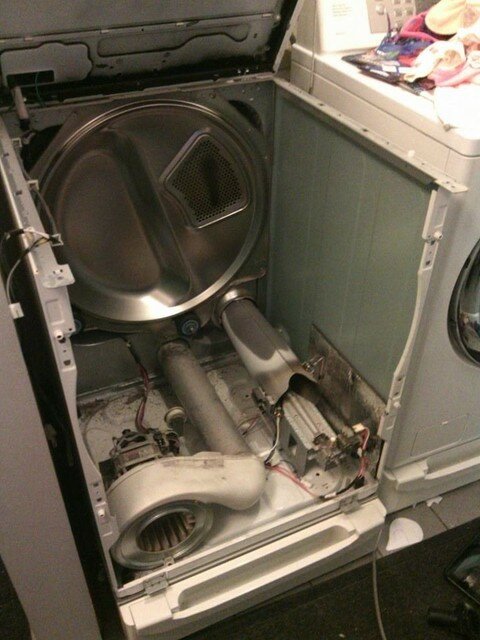
I pretty much tore it down to bones so I could reach all the stuff to test and the end result was simply a popped circuit breaker on the high limit thermistor. All I had to do was push a little button and had I known that I could have avoided taking out the drum entirely. Here’s a picture of the little f**ker.

See that little black nub between the red and white wires? Push that and you get heat. Yes it’s that simple….four screws and you can reach it and fix it but only if you know that’s the problem. However as I tore the dryer apart and saw all the lint inside I wasn’t actually too upset. I also found two of the drum wheels were pretty close to seizing (damn hair buildup) so it gave me a chance to clean them and prevent a future near failure. So all’s well that ends well…I paid nothing and hopefully just a reset and cleaning will keep the dryer going for a long time.